
Travertine vs Porcelain for Pool Surrounds in Melbourne
Both are premium, both look great around a pool, and both cost about the same laid. The right choice depends on how you use the pool, how much maintenance you're happy with, and the look of your house.
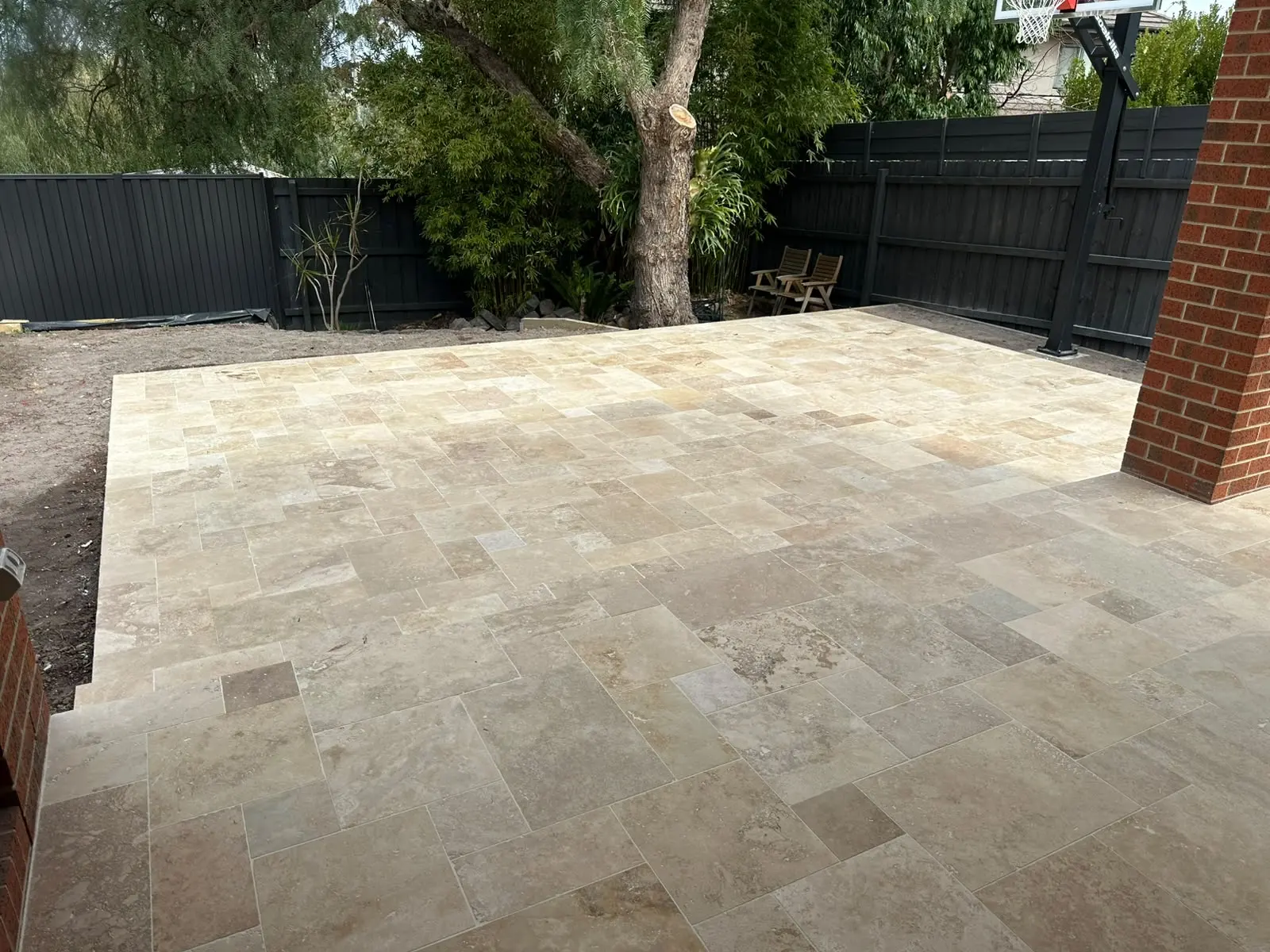
The short answer
Choose travertine if you want a natural stone look, a surface that stays cooler underfoot in summer, and you don't mind sealing every few years. Choose porcelain if you want a crisp, consistent modern finish that never needs sealing and shrugs off stains. Around most Melbourne pools, both perform well when they're laid on a proper base with the right falls, the laying matters more than the material.
Heat underfoot
This is the question we're asked most. Light-coloured tumbled travertine is one of the coolest paving surfaces you can put around a pool. Its natural pores and pale tones reflect heat, so it's comfortable for bare feet on a hot January afternoon. Porcelain can also stay reasonably cool in pale colours, but dark porcelain in full sun gets hot. If your pool area is exposed to afternoon sun and kids run around barefoot, lean toward pale travertine or a light-coloured porcelain.
Grip and safety
Around a pool, slip resistance is non-negotiable. Tumbled and brushed travertine has a naturally textured surface that grips well when wet. Polished travertine does not belong around a pool. With porcelain, you must choose a product rated for outdoor wet areas, usually labelled with an R11 or P5 slip rating or a textured 'grip' finish. Indoor porcelain tiles are too slippery for a pool surround, no matter how good they look in the showroom.
Salt and chlorine
Saltwater pools are common in Melbourne and salt is hard on some stones. Dense, good-quality travertine that is properly sealed handles salt well; cheap, soft travertine with large voids can deteriorate over time. Porcelain is almost immune to salt and chlorine because it's non-porous. If you have a saltwater pool and want the lowest maintenance, porcelain has the edge.
Maintenance
Travertine should be sealed after installation with a sealer suited to pool areas and resealed every few years depending on sun and use. Its natural holes can be filled at the factory or left open for a rustic look. Porcelain needs no sealing. A hose-down and occasional clean is enough. Both need the joints kept in good condition.
Look and style
Travertine suits Mediterranean, Hamptons, period and warm contemporary homes. French pattern (a mix of four sizes) is the classic layout and hides small level differences beautifully. Porcelain suits modern homes with render, black window frames and clean lines. Large-format porcelain in a stone-look or concrete-look finish gives a calm, resort-style surround with fewer joints.
Cost in Melbourne (2026)
| Item | Guide price |
|---|---|
| Travertine paving, supplied and laid | $310–$350/m² |
| Porcelain paving, supplied and laid | $200–$270/m² |
| Pool paving (either material, incl. pool-specific detailing) | $230–$330/m² |
| Pool coping | $220–$500 per metre |
Try our paving cost calculator for your size. These are guide prices only (inc GST). Every job is different. Your price depends on the size, access, base, drainage and material you choose, so it can come in lower or higher. Send photos and rough measurements to 0406 170 544 for a rough price first, then we visit for free and give you a fixed written price.
Laying makes the difference
Whichever material you choose, the surround has to fall away from the pool and the house toward drains or garden beds, sit on a solid compacted base, and meet the coping with a proper expansion joint. Large-format porcelain also needs a flat, fully supported mortar bed or the corners can lip. These are the details that decide whether a pool area still looks right in ten years.
Which lasts longer?
Both last decades when laid well. Porcelain keeps its colour and surface almost indefinitely. Travertine slowly softens and develops a patina, which many people like, and can be honed back if needed.
Joints, grout and borders
Travertine in French pattern is usually laid with tight joints filled with sand or grout; porcelain is laid with consistent, narrow grouted joints. Around a pool, joints must stay sealed so water doesn't get under the paving. A border in the same stone or a contrasting bluestone frames the surround and makes the transition to lawn or garden neat.
Mixing materials
A popular Melbourne combination is pale travertine for the surround with bluestone coping, or porcelain on the alfresco under the roof with matching outdoor-grade porcelain around the pool. Keeping colours in the same family ties the areas together while using each material where it performs best.
Questions to ask any installer
- What base depth and bedding will you use, and is it a mortar bed for large-format porcelain?
- What slip rating does the product have for wet areas?
- How will the surround fall, and where will the water go?
- Is there an expansion joint between the coping and the paving?
- What sealer do you recommend, and how often should it be reapplied?
Our recommendation
- Pale tumbled travertine for comfort, warmth and a natural look, especially for families with kids.
- Outdoor-rated large-format porcelain for a crisp modern finish and the lowest maintenance, especially for saltwater pools.
- Matching coping in the same material so it all reads as one surface, or bluestone coping as a contrast.
If you'd like to see both side by side, Antonio brings samples to every site visit so you can compare them in your own light, next to your house and pool.
Related services
From our recent work
Frequently Asked Questions
Is travertine or porcelain cooler around a pool?
Pale tumbled travertine is generally the cooler of the two. Pale porcelain is fine; dark porcelain gets hot in full sun.
Is porcelain slippery around a pool?
Only if you use the wrong product. Choose outdoor porcelain with a wet-area slip rating (such as R11/P5) or a textured grip finish.
Does travertine need sealing?
Yes, seal after installation with a pool-suitable sealer and reseal every few years.
Which is better for a saltwater pool?
Porcelain is the lowest-maintenance choice for salt. Dense, well-sealed travertine also performs well.
What Melbourne Homeowners Say
★ 5.0 Google · 72 reviews · $20M insured · 1‑year workmanship warranty
Antonio completed our bluestone paving in Hampton and the result is outstanding. The levels, drainage and finishing details are flawless. Highly recommended for high-end paving.
We had a fairly complicated drainage issue on the site, but Antonio came up with a solution and executed it perfectly. The workmanship was top quality, and there were no unexpected surprises along the way.
Antonio runs a very professional small business. Friendly, punctual and hard working. Built 2 retaining walls and remodelled our driveway paving. Would use Antonio's service again.
Antonio and his colleague did a great job with our backyard brick laying. Easy to deal with, on time and professional.
Antonio just completed some brick paving alongside our front fence. The paving looks fabulous and was completed in 2 days. He was reliable and the work was completed to a high standard.
Antonio cleared out our small backyard, laid some pavers and built a step around our existing deck. He was quick to respond, well priced, and was happy to change and vary the scope of works as needed.
Get a Free Written Quote
Send a few details and photos. Antonio will reply the same day (Mon–Sat).