📍 Location: Mount Waverley, VIC
📐 Size: 55 m²
⏱ Duration: 5 days
🧱 Materials: Recycled clay bricks, crushed rock base, polymeric sand
💰 Budget: $5,800 (approx. $105/m²)
Project Overview
This Mount Waverley project involved a full replacement of an old, cracked concrete driveway that had been failing for years. The homeowners, located in a quiet street off Stephensons Road, contacted us after noticing that their existing concrete slab was not only unsightly with multiple cracks but also causing water to pool near their garage entry. Water was seeping under the slab through the cracks and saturating the clay soil beneath, creating soft spots and a constant dampness issue.
After an initial site inspection and consultation, we recommended a recycled brick driveway laid in a classic herringbone pattern. Recycled clay bricks offered the perfect blend of durability, character, and environmental responsibility — each brick carries decades of patina that new pavers simply cannot replicate. The homeowners loved the idea of giving old materials a second life while gaining a driveway that would outperform concrete in every way.
The Situation — What We Found
The existing driveway was a 55m² concrete slab that had been poured approximately 25 years earlier. It had developed significant cracking across the full width in three places, with one section displaced by nearly 20mm. The surface was uneven, and the fall toward the garage meant that rainwater ran directly into the garage rather than being diverted away. Poor drainage at the property line had also saturated the underlying clay soil, which is typical across much of Mount Waverley and the surrounding south-east Melbourne suburbs.
The site had a noticeable slope from the street down toward the garage, adding complexity to the base design. The clay soil — Melbourne's notorious heavy clay — would need to be excavated deeper than a standard driveway to reach stable, load-bearing ground. Without addressing this, any new surface would fail within a few years just like the old concrete had.
The Solution — Our Approach
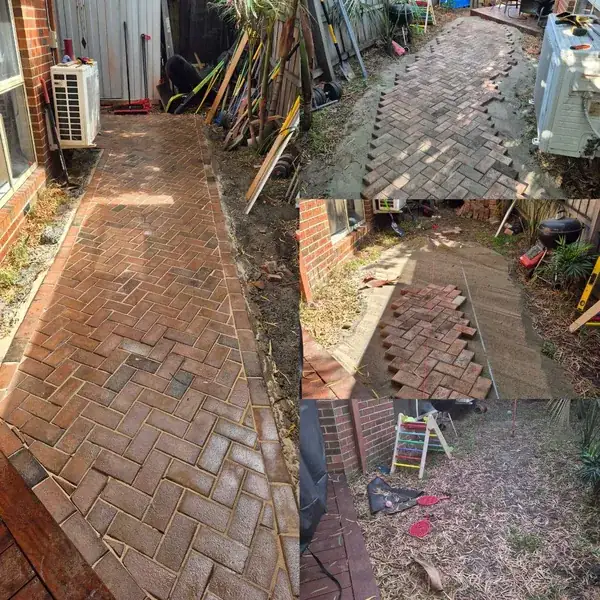
We began by demolishing and removing the old concrete slab, which came out in large sections thanks to a Komatsu mini-excavator. The broken concrete was trucked away for recycling — keeping the project as sustainable as possible. Once the slab was gone, we excavated an additional 250mm below the planned finished surface level to remove the soft, moisture-laden clay and replace it with engineered fill.
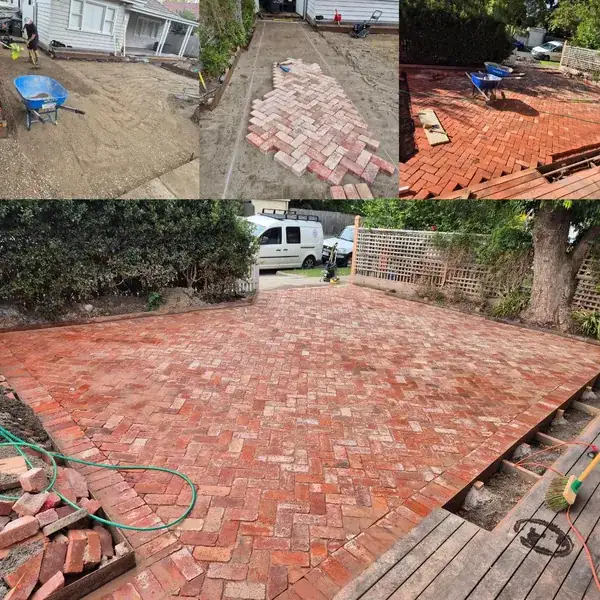
The base was built in layers: 250mm of 20mm crushed rock (road base) was placed and compacted in 100mm lifts using a vibrating roller. Each lift was moisture-conditioned and compacted to 98% Standard Proctor density. On top of the road base, a 30mm layer of coarse washed bedding sand was screeded to precise levels, accounting for the cross-fall that would direct water away from the garage and toward the garden beds.
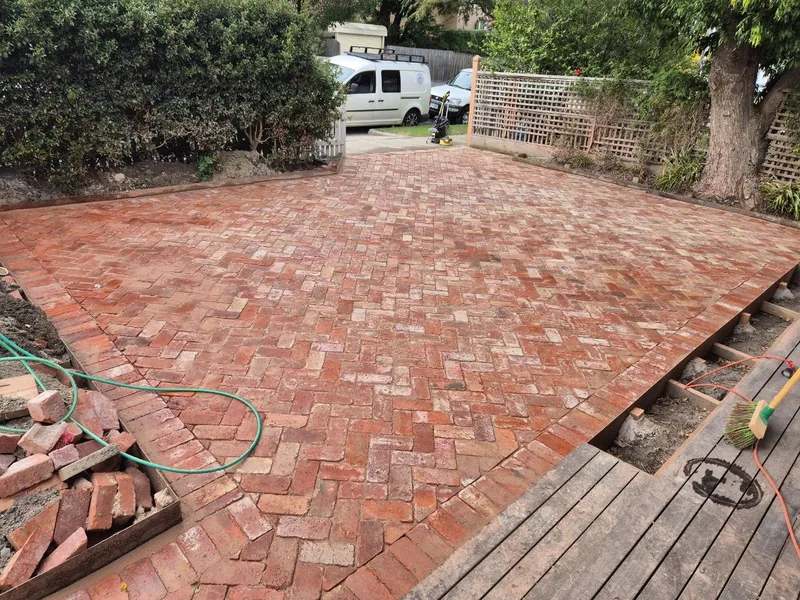
We selected recycled clay bricks salvaged from a demolition site in Notting Hill — these were solid, wire-cut bricks with a warm terracotta colour and slight variations in shade that gave the finished driveway incredible character. The bricks were laid in a 90° herringbone pattern, chosen because it provides the strongest interlock for vehicle traffic and looks stunning when complete. Concrete edge restraints were installed along both sides and the top to lock the pavers in place and prevent lateral movement.
Once all bricks were laid and compacted with a plate compactor fitted with a rubber pad, we swept polymeric sand into the joints and activated it with a fine water mist. The sand hardens into a flexible, permeable seal that prevents weed growth and ants while still allowing water to drain through. Finally, the entire surface was cleaned and sealed with a penetrating paver sealer to enhance the brick colours and provide stain resistance.
Challenges on Site
The biggest challenge was the clay soil. Mount Waverley sits on a deep layer of basaltic clay that becomes plastic and unstable when wet. We had to excavate an extra 100mm deeper than originally planned to reach competent ground, which meant additional imported crushed rock and an extra day of compaction work. The slope also required a stepped base design — rather than a uniform depth, the base thickness varied from 250mm at the street end to 350mm at the garage to maintain a stable platform on the incline. Access was tight too — the driveway sat between the house and a fence with only 3.2m clearance, limiting our machinery choices to a compact excavator and a walk-behind roller.
Materials Used
- ✅ Recycled clay bricks — salvaged from Notting Hill demolition, ~2,200 bricks
- ✅ 20mm crushed rock (road base) — 14 tonnes, compacted in layers
- ✅ Coarse washed bedding sand — 3 tonnes
- ✅ Concrete edge restraints — 22 linear metres
- ✅ Polymeric sand — joint stabilisation
- ✅ Penetrating paver sealer — surface protection
- ✅ Geotextile fabric — separation layer between clay and road base
Project Timeline
Day 1: Demolition and removal of old concrete slab (trucked for recycling).
Day 2: Excavation of clay soil, installation of geotextile fabric, first lift of road base compaction.
Day 3: Second and third lifts of road base, final grading and compaction.
Day 4: Bedding sand screeding, brick laying in herringbone pattern, concrete edge restraints.
Day 5: Compaction, polymeric sand jointing, sealing, clean-up, and handover.
Why Recycled Brick for Mount Waverley?
Recycled brick driveways are becoming increasingly popular in Melbourne's south-east suburbs, and for good reason. They offer unmatched character — no two bricks are identical, and the aged patina creates a warm, established look that suits both period homes and contemporary architecture. They're also one of the most sustainable paving options available, keeping thousands of bricks out of landfill and avoiding the energy costs of manufacturing new pavers. In terms of performance, recycled clay bricks are just as strong as new ones — they're fired at over 1,000°C and can handle vehicle traffic for 50+ years when installed on a proper base.
For Mount Waverley homeowners dealing with clay soil and sloping sites, the key takeaway is that the base is everything. A beautiful brick surface will fail if the foundation isn't right. That's why we invest the time in proper compaction, geotextile separation, and engineered drainage — it's the difference between a driveway that lasts 5 years and one that lasts 50.
Interested in a similar project for your Mount Waverley home? We service all of Melbourne's south-east suburbs including Notting Hill, Glen Waverley, Wheelers Hill, Mulgrave, and Clayton. Learn more about our brick paving services or see what we do in Mount Waverley.
Frequently Asked Questions
Why choose recycled brick for a driveway in Mount Waverley?
Recycled clay bricks offer a unique aged character that new pavers can't match, plus they're an environmentally sustainable choice. They're equally durable — fired at high temperatures — and when laid on a proper compacted base they last decades. In Mount Waverley's clay soil suburbs, the key is always the base preparation, not the paver itself.
How is drainage handled on a sloped driveway like this Mount Waverley project?
On sloped driveways, we build a stepped base that contours the natural slope, with a fall of roughly 1:60 to channel water away from the house and garage. A 250mm crushed rock base acts as a capillary break, and polymeric sand joints prevent surface water from penetrating through. Additional ag lines can be added at the low point if needed.
How long does a recycled brick driveway take to install?
A recycled brick driveway of 55m² typically takes 4–6 days from demolition to completion. Day 1 is demolition and excavation, days 2–3 are base preparation and compaction, day 4 is brick laying, and day 5 is edging, sanding, and sealing. Clay soil sites may add an extra day for deeper excavation.
 Antonio PrimeScape Construction